



Longer retirements can support continued allocations to private markets, but decumulation places greater emphasis on cashflows, liquidity and the ability to respond to changing member needs.
Private markets a likely to have a role to play in DC portfolios long after members retire. But the assets that schemes choose – and the amount of illiquidity they can tolerate – will change as the emphasis shifts from accumulation to generating income.
Speakers at Longview Networks’ DC Decumulation Investment Forum yesterday argued that longer retirements challenged conventional approaches to de-risking, potentially leaving schemes with considerable investment horizons after members begin drawing their pensions.

The need to meet withdrawals and retain flexibility also creates constraints that are less pressing during accumulation. Rather than simply carrying existing private market allocations into retirement, schemes are likely to rotate into assets capable of generating predictable cashflows and allow them to carefully manage overall liquidity.
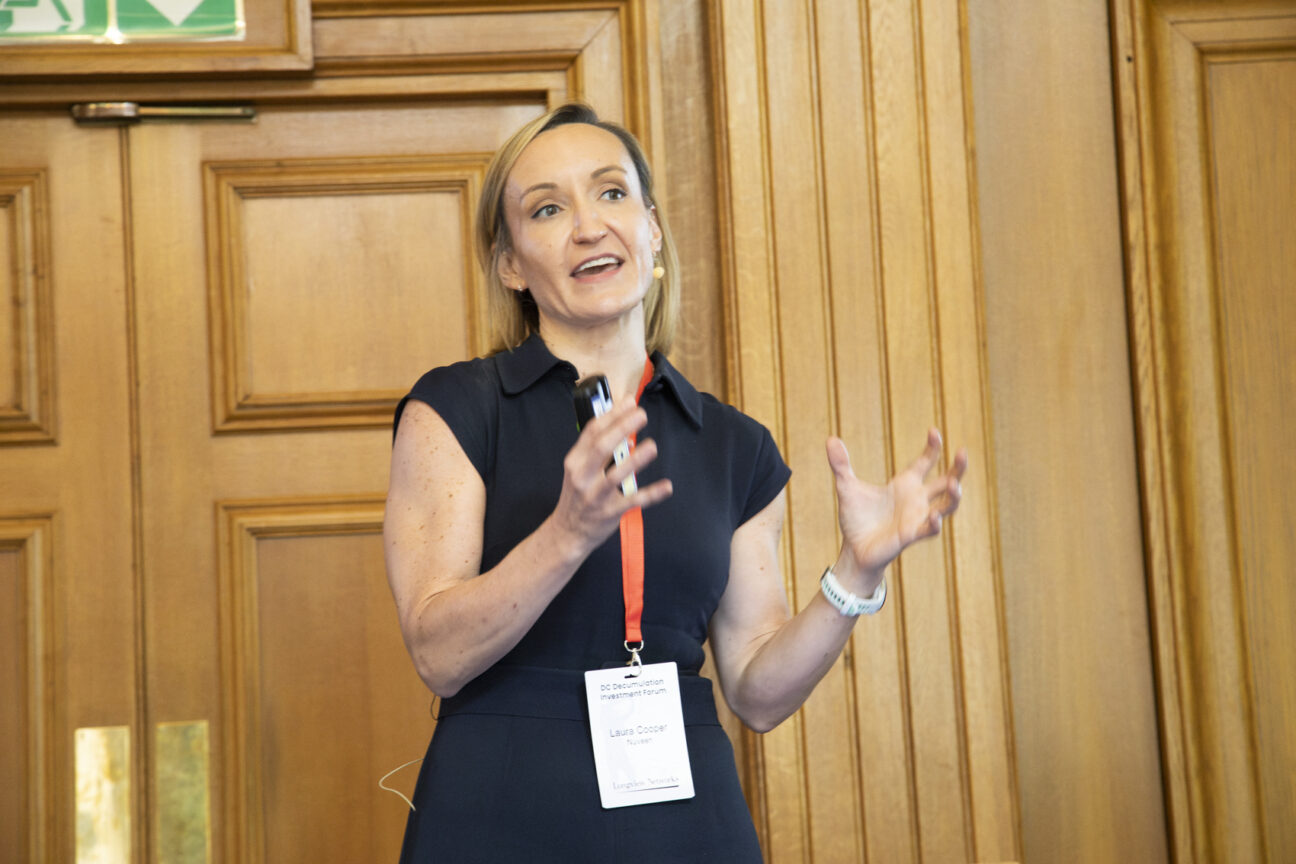
Laura Cooper, head of macro credit and global investment strategist at Nuveen argued that public and private credit could perform complementary roles in such a portfolio, with public credit providing income and the ability to rebalance while private assets potentially enhancing yield and diversification.
Private credit, she stressed, encompasses assets with very different characteristics. For example, investment-grade private corporate credit can provide contracted cashflows, while asset-backed finance can offer shorter-duration exposure backed by a wide variety of balance sheet assets. Infrastructure debt can provide long-dated contracted cashflows that capture structural investment themes, while real estate debt offers short-dated income with risk diversified across locations.
DC Asset Allocation Forum | 26 January 2026 | London
The trade-off relative to public markets is of course decreased liquidity, but this downside can be mitigated by combining both types of asset. Cooper illustrated how a portfolio can be constructed to combine public credit with private investment-grade infrastructure debt and asset-backed finance, to increase the indicative yield from around 5.3% for an all-public portfolio to around 5.8%.
“If you go into private credit, fully diversified, you’re looking at about a 50 basis point uplift,” she said.
Cooper cautioned that private assets bring valuation lags, higher fees and greater dispersion between managers. The appropriate allocation therefore also depends upon when members are likely to require their money. “Liquidity is still key,” she said. “You’ll always need to have public exposure to make sure that you’re able to pay your members.”
One way to reconcile competing requirements is to divide retirement assets according to when they will be needed. Cooper suggested holding cash and short-dated credit against near-term spending, public markets for medium-term requirements and private assets within a longer-term allocation.
No perfect asset
Taylor Weeks, head of strategic delivery, retirement solutions, at Schroders, approached the problem from the perspective of targeting retirement cashflows.
Rather than concentrating primarily on portfolio volatility, he argued that retirement strategies should consider the stability of the income they are intended to provide.
He suggested that retirement assets should be divided into sections with different objectives rather than through a single portfolio. Cash could be held to meet unexpected expenditures, guaranteed income could cover essential spending, while other assets could support discretionary expenditure and longer-term growth.
For the lifestyle spending component, the ideal asset would combine high returns, resilient cashflows, inflation protection and liquidity. “The problem is, this perfect asset doesn’t exist,” Weeks said. “You can’t have all [four attributes] at the same time.”
Institutional investment Conferences & Summits from Longview Networks
Private assets can nevertheless provide several of those characteristics. Weeks used offshore wind power generation as an example of an asset capable of generating naturally amortising and predictable long-term cashflows, alongside explicit inflation linkage during its contracted period. “But it’s illiquid,” he noted.
The challenge is therefore to combine assets with different characteristics so the overall portfolio can produce the required cashflows, rather than relying on any individual asset class to meet every requirement.
He added that diversification is particularly important in drawdown portfolios because they are exposed to sequencing risk. Weeks illustrated how investors starting retirement only a few years apart could experience significantly different outcomes when following the same investment strategy.

Liquidity budget
The amount schemes can allocate to private markets may partly depend on their scale as well and what retirees plan to do during decumulation.
“The more scale you have, the more cohorts you can do on a granular basis,” Weeks said. “But also… the more you can use private markets because you’ve got more liquidity.”
Initially, however, he expects providers to be cautious. Schemes do not yet know how frequently members using flexible retirement solutions will make unexpected withdrawals. Over time, experience should provide schemes with greater confidence about their liquidity requirements.
Dan Bertram investment proposition manager at Aviva said: “Hopefully, particularly in a master trust environment, I think we’ll find that people tend to stay the course within the fund.”
If that proves correct, he added, “we could start to see the illiquidity budgets in some of these solutions increase”.
Thomas Duetoft, senior portfolio manager and head of client solutions at Pemberton Asset Management, argued that private credit could contribute contractual income and an illiquidity premium during both accumulation and decumulation.

However, he suggested the type of exposure should vary between the two phases. Senior and mid-market debt, together with shorter-duration working-capital finance, could potentially support retirement portfolios, while more complex and higher-return strategies may be better suited to accumulation.
But Paul Tinsley, a professional trustee at Dalriada Trustees, questioned how schemes should balance that additional income against the flexibility retirees require – particularly if rising gilt yields make annuities increasingly attractive.
“As trustees, we have to think about those kinds of eventualities,” he said. “One of the things we’re always measuring is the ability to produce an income.”
Duetoft acknowledged that traditional direct-lending investments cannot simply be switched off when circumstances change. However, he said institutional demand for evergreen structures was increasing and described requests for portfolios capable of directing cashflows between longer- and shorter-duration credit strategies as requirements change.
The attraction of higher income must also be considered alongside credit risk. Duetoft said defaults were increasing and stressed the importance of selecting managers capable not only of originating loans but of restructuring businesses when investments encounter difficulties.