



Private markets have changed dramatically in recent years – and the next phase could be just as transformative. As investors adapt to a more complex environment, Franklin Templeton explores three key trends reshaping portfolios
Private markets evolution: new rules, new opportunities
Private markets are changing fast. Years of ultra-low rates fuelled rapid growth and institutional adoption, with investments delivering desired outcomes.
But that era has ended. Slower exits, tighter capital, and greater scrutiny are challenging old assumptions. Investors are rethinking how they allocate capital, manage risk, and access opportunity.
New themes are emerging. Liquidity is back on the agenda. Private credit is expanding into new frontiers. And the lines between public and private markets are blurring.
In this article, we explore three trends – drawn from Franklin Templeton’s latest ten trends paper – shaping opportunity in 2026 and beyond.
(Im)patient capital: Liquidity moves up the agenda
One of the clearest signs of change is the renewed focus on liquidity. The traditional model – commit capital, wait years, receive outsized returns – is being tested. Investors face longer hold periods and slower exits, particularly in private equity.
Distributions from recent vintages have fallen short. A key metric is distributions to paid-in capital (DPI), which tracks cash returned relative to commitments. For US buyout funds launched between 2018 and 2022, DPI is running at roughly half the historical average – and allocators are taking note.
Lagging Distributions and a Need for DPI May Shift How Private Allocations are Built
US PE Buyout Fund DPI by Age and Vintage Year, As of December 31, 2024

Source: PitchBook, 2Q2025 Quantitative Perspectives. Note: 2006–2014 values are averaged across each time bucket. Shading represents the difference from mean 2006–2014 values
In response, investors want more flexibility. Strategies that return capital sooner and offer clearer exit paths are gaining traction. Evergreen funds, NAV-based lending, and secondary solutions are no longer niche – they’re becoming essential liquidity tools.
Managers are responding with innovation. But for investors, the challenge is identifying genuine flexibility. The ability to rebalance, respond to market shifts, and manage cashflows is now a competitive advantage.
This growing demand for liquidity also shapes how investors think about credit, setting the stage for the next trend.
Private credit diversifies into new frontiers
As investors seek greater flexibility and more dynamic capital deployment, private credit is stepping into the spotlight – not just as a liquidity tool, but as a long-term portfolio building block.
Initially driven by dislocation in traditional lending markets, private credit is now a $1.7 trillion asset class – and growing fast. With potential approaching $30 trillion, it’s expanding beyond middle-market lending into consumer finance, infrastructure, real estate debt, and more.
Asset-Based Lending Opens US$30T Frontier for Private Debt
Private Credit and Potential Pools of New Lending Assets (US$tn)
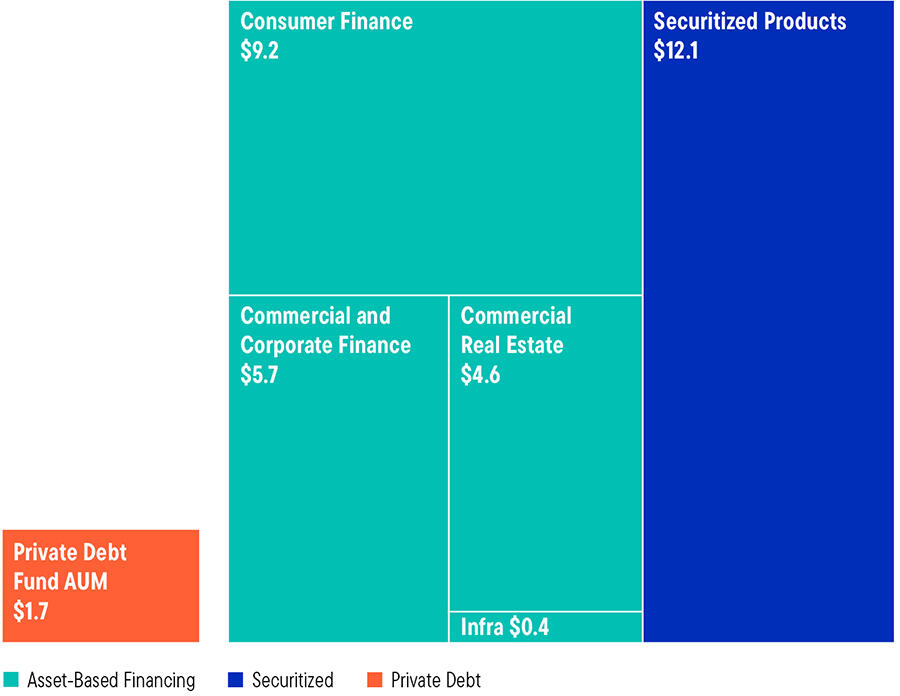
Sources: PitchBook, McKinsey & Co. SIFMA. Private credit AUM as of 2024. Asset-based financing sizes based on US lending balance on bank and non-bank balance sheets as of 2023. Securitized products size based on SIFMA estimates as of 2022.
This evolution is turning private credit into a core income and diversification strategy. But with expansion comes complexity. As the asset class enters new frontiers, allocators must balance opportunity with due diligence. Sector expertise, sourcing networks, and underwriting discipline are critical.
The next phase of growth will be defined by selectivity. Investors must assess not just the asset class, but the platform – favouring managers who can navigate new sectors without compromising quality.
And as private credit grows, it’s increasingly overlapping with public markets – leading to the third trend.
Public and private credit converge
As private credit scales and enters new sectors, it’s reshaping the broader credit landscape. The traditional divide between public and private markets is fading, with issuers increasingly moving between them to find the most efficient capital source.
For investors, this convergence is a chance to rethink credit as a spectrum – and build diversified portfolios spanning both public and private exposures.
As a result, multi-asset credit strategies are gaining ground. These approaches allocate dynamically across instruments, geographies, and structures – offering broad credit exposure while managing liquidity.
But convergence also raises new questions. How do you benchmark performance across such diverse exposures? Manage structural risks in hybrid portfolios? Ensure governance and transparency across credit types?
The answer lies in integration. Investors are increasingly favouring managers with cross-market capabilities – those who can deliver hybrid solutions, simplify access, and manage complexity. In a converged world, the ability to see the full picture – and act on it – is a strategic advantage.
Putting these trends to work
These three trends are reshaping how investors engage with private markets. They reflect deeper shifts in investor expectations, market dynamics, and portfolio construction.
And they’re just part of the story. In Franklin Templeton’s latest paper, Top Ten Private Market Trends for 2026 and Beyond, we explore broader forces driving change – from AI in deal sourcing, to the growing role of impact and ESG, to the evolution of fund structures and access models.
For investors, the message is clear: private markets are no longer just about long-term illiquidity premiums. They’re about agility, innovation, and alignment. Recognising and responding to these trends will be key to capturing the opportunities ahead.
Explore all ten trends in our latest paper: here.