


Carbon Limiting Technologies’ Melody Chiu and University College London professor Chris Rapley, a Clean Growth Fund advisory board member, highlight the carbon emissions and waste pollution resulting from plastic – and suggest solutions.
Plastics are everywhere. From packaging to products, their convenience has made them indispensable and their use is growing rapidly. But this convenience comes at a steep environmental cost. Produced from fossil fuels, every stage of their production contributes to carbon emissions (Figure 1). Compounding this, most are not biodegradable. Plastics pollute twice: first as carbon emissions, then as long-lasting contamination.
Figure 1 – Plastic-related GHG emissions
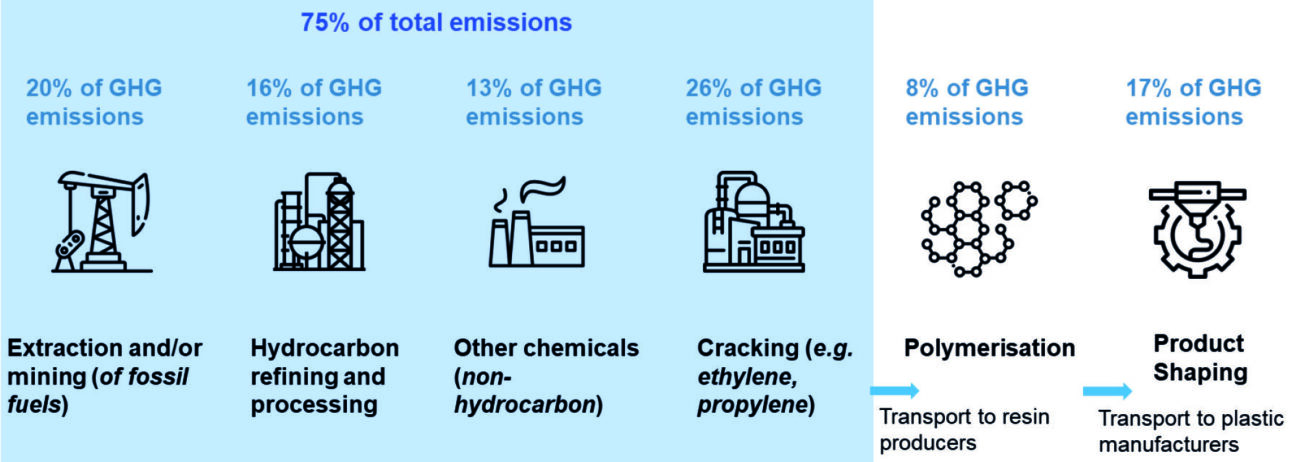
Source: Climate Impact of Primary Plastic Production, Lawrence Berkeley National Laboratory (2024)
A sustainable strategy
Plastic demand is accelerating and the EEA projects global production will double or even triple by 2050, with oil and gas companies investing heavily in expanding production. Even under a conservative 2.5% per year growth scenario, GHG emissions from plastic production – currently c. 4.5% of the global total – will double (Figure 2). For the UK to hit net zero by 2050, eliminating plastic-related emissions will be critical.
Figure 2 – Plastic GHG emissions growth

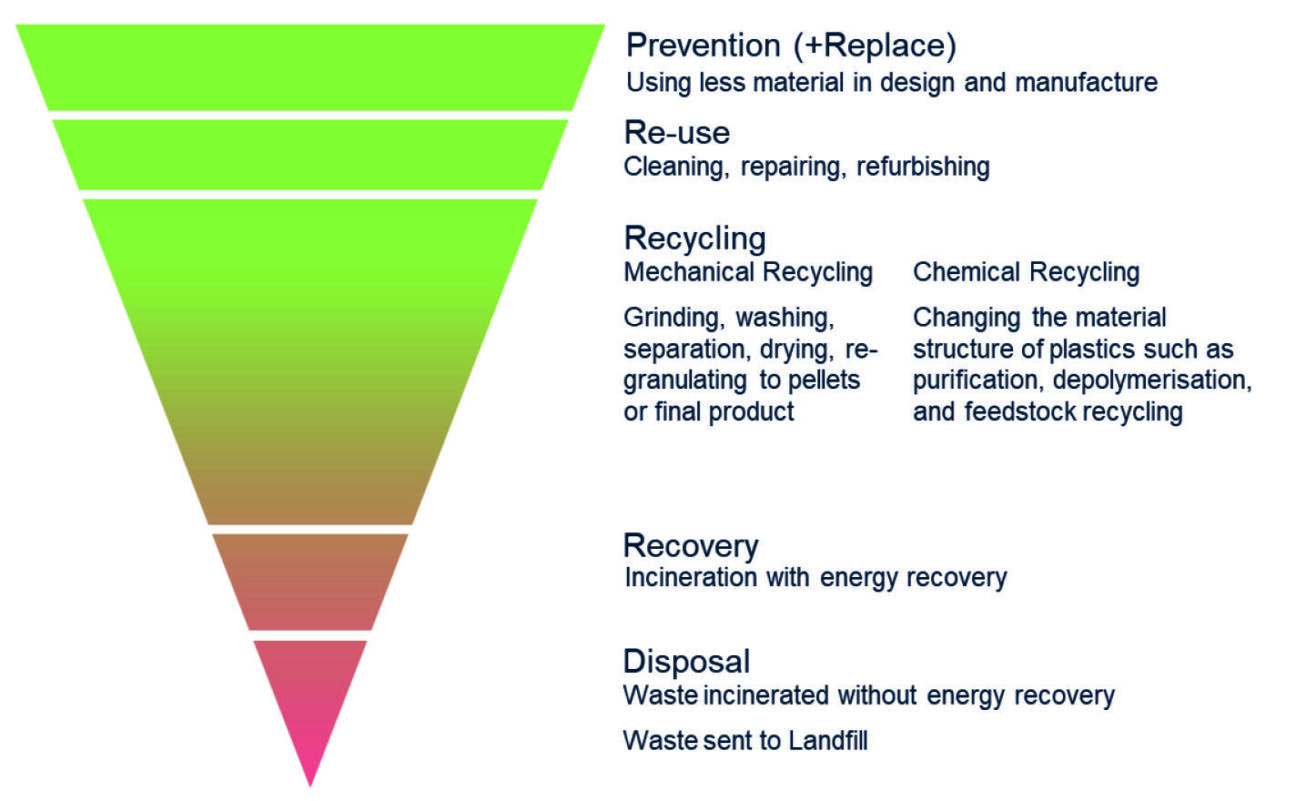
Reducing plastics emissions requires a strategic approach. The globally-recognised Plastic Waste Hierarchy (Figure 3) makes it clear that not all solutions are equal; prevention is the most effective strategy, followed by reuse. Recycling is the next-best option.
However, 73% of plastic waste in Europe is still incinerated or sent to landfill, which Plastics Europe says are most damaging methods. The UK has an opportunity to lead by example, shifting towards prevention, reuse and a circular economy to cut emissions, reduce waste and strengthen resource security.
Figure 3 – The Plastic Waste Hierarchy
Barriers and solutions
The plastics industry faces significant challenges in decarbonisation. Terms such as ‘bioplastic’ are often misunderstood by consumers and this leading to improper disposal. Under EU definitions, bioplastics can still be fossil fuel-based or non-biodegradable.
The countless forms of plastic each have different properties and recyclability. Supermarket cling films made from PVC and LDPE look similar, yet PVC contaminates recycling streams and LDPE does not. Without clear guidance and policy intervention, these barriers will continue to undermine progress.
The scale of the challenge may seem daunting, but there are clear priorities. 75% of plastic’s lifecycle emissions occur before the production of its main ingredients: polymers. 58% of total plastic emissions come from just three plastic types – PET, PP and PE – which are mainly used for packaging. Packaging consumes nearly 40% of global plastic demand and only 28% of plastics were recycled in the UK, according to Plastics Europe.
The UK market is actively addressing these challenges. A notable example is the UK Plastics Pact, led by the Waste and Resources Action Programme (WRAP), that unites businesses across the value chain to pilot innovative solutions and establish best practices. Alongside WRAP’s efforts, various industry players are driving progress through independent and collaborative actions.
Specific initiatives being pursued across the sector include:
1. Eliminating fossil inputs
Innovators are creating new plastic materials to reduce reliance on fossil fuels, primarily through two approaches: bio-based plastics and biodegradable materials (Figure 4).
Bio-based plastics utilise organic sources such as starch (e.g. potatoes, corn), cellulose (e.g. sugarcane), chitin (e.g. mushrooms, seaweed) and materials produced by microorganisms. These alternatives aim to lower emissions by replacing fossil-based feedstocks.
Biodegradable plastics are designed to decompose into natural substances under specific conditions. Compostable plastics meet stricter criteria, including breaking down without releasing toxins, and can even support plant growth. Industrially compostable plastics require controlled conditions in composting facilities to degrade fully while home compostable plastics can break down in well-maintained home systems.
Compostable plastics are promoted as a solution for hard-to-recycle, food-contaminated items such as fruit stickers and tea bags. Waitrose partnered with WRAP to trial selling loose fruits without packaging, offering compostable plastics for customer use. This provided valuable insights that enabled WRAP to publish guidelines for retailers to encourage consumers to reduce plastic use.
Figure 4 – Properties of bioplastics

2. Encouraging impactful recycling
Effective recycling is a cornerstone of the circular economy, preventing plastic waste from polluting the environment. While all plastics are theoretically recyclable, economic and logistical barriers limit real-world recycling rates. PET and HDPE, commonly used in water and milk bottles, are the most recycled due to established markets and infrastructure. In contrast, multi-layered or contaminated plastics often end up in landfills or incineration as recycling is not economically viable.
There are two broad methods for recycling. Traditional mechanical recycling shreds and reforms plastics without altering their chemical structure. However, it requires clean, single-polymer plastics, making it unsuitable for contaminated or mixed materials. UK innovator LabCycle is improving sorting and decontamination technologies to recycle lab plastic waste instead of incinerating it.
Chemical recycling breaks plastics down at the molecular level, enabling the processing of previously unrecyclable materials. A leading example is Mura Technology’s Teesside-based chemical recycling plant, which is set to begin operations this year with a process that can efficiently and cost effectively recycle mixed plastics.
Chemical recycling should complement, not replace, mechanical recycling. While mechanical recycling is faster and more resource-efficient, chemical recycling addresses contamination and quality issues, ensuring more plastics remain in the circular economy.
3. The ultimate solution: reducing use
No single solution is perfect; each comes with trade-offs that must be carefully managed.
Bio-based plastics offer an alternative to fossil fuel-based plastics, but large-scale production raises concerns about competing with food crops, shifting the environmental burden to land and water use. Compostable plastics face real-world challenges as ideal degradation environments are often unavailable. They are also frequently treated as contaminants in conventional recycling facilities and suffer from misuse due to consumer confusion over terminology. And recycling is not carbon-neutral – it emits CO₂ and often requires virgin plastic inputs to maintain material quality.
These challenges reinforce the Plastic Waste Hierarchy: reducing overall plastic demand must remain the top priority in building sustainable solutions. Businesses need to prioritise reducing plastics’ environmental impact across their supply chains rather than making decisions based on broad assumptions about which materials appear best.
A strategic, evidence-based approach is critical. For example, Carbon Limiting Technologies is hosting roundtables for corporate leaders, providing in-depth research and industry examples to help reduce Scope 3 emissions. These insights are vital for businesses to develop effective strategies that deliver lasting progress.
A truly circular economy would eliminate plastic use, reserving it only for essential applications – designed for reuse or made from compostable materials. Any unavoidable waste would be fully recycled into new plastics, ensuring nothing is discarded.
While this ideal scenario remains out of reach, innovative solutions are narrowing the gap between ambition and reality. Some UK businesses are already making strides towards sustainable plastic use. Policymakers have a vital role in reducing plastic waste, improve recycling and incentivise sustainable alternatives by aligning regulation, investment and public engagement towards a circular economy.
Key actions
The UK has a unique opportunity to lead the global transition to a circular plastic economy. There are five critical next steps for policy markers: strengthen regulations with clear terminologies; eliminate problem plastics; mandate 100% reusable, recyclable or compostable packaging; accelerate investment in recycling infrastructure; and foster cross-sector collaboration.
Institutional investors can support the next generation of sustainable technologies by investing in vehicles such as the Clean Growth Fund. For example, one recent investment was in Arda Biomaterials. Arda aims to transform waste into a leather-alternative that is entirely animal and plastic free. Its first transformation involves turning waste grain from the beer brewing industry into a leather alternative for fashion, home goods, upholstery and other uses.
The time for action is now. Plastic pollution is a global crisis that demands immediate, bold and unyielding action. By implementing clear and stringent regulations, enforcing uncompromising producer accountability, and investing in ground-breaking innovative solutions, the UK can establish itself as the leader in the battle against plastic emissions and pollution.