



As private credit markets expand, institutional investors are looking beyond traditional direct lending strategies and paying closer attention to portfolio construction, liquidity management and manager selection.
Private credit investors are increasingly broadening their opportunity set beyond traditional direct lending onto more niche opportunities, according to speakers at Private Markets Profile’s Private Credit Forum.
While direct lending remains a core allocation for many institutional investors, panellists argued that the market has become significantly more diverse, creating opportunities across investment-grade private credit, asset-backed finance and other specialist strategies.

Peter Smith, investment director at TPT Investment Management, said the market had evolved considerably since the years following the global financial crisis. “It’s now actually a financial system in itself. It does a lot of things that banks just will not do.”
Private credit now provides access to parts of the market that are increasingly difficult to reach through public markets. “If you want access to infrastructure debt – maybe you want some duration in your portfolio with high credit rating – you’re going to have to go into private credit,” Smith said. “There’s just no alternative.”
Umang Rajbhandari, director in the private credit team at bfinance, said institutional demand remained strong, particularly in European direct lending. “Our clients see private credit as a broad range of different sub-asset classes,” he said. “We’re still seeing a lot of clients interested in European direct lending.”
However, both speakers highlighted growing interest in investment-grade private credit. Smith noted that improving DB funding levels had led schemes to explore opportunities that can support endgame and run-on objectives, while Rajbhandari said some managers are launching evergreen structures focused on the investment-grade market.
Hear about local investment strategies at the Room 151’s LGPS Private Markets Forum
The speakers also highlighted the importance of matching structures to investor objectives.
While evergreen vehicles have become increasingly popular, Smith cautioned against viewing them as a source of immediate liquidity. “The way you tend to get out of these evergreen structures is they take a vertical slice of the portfolio and put you in a runoff portfolio,” he said. “You might get 50% of that back within six months… the other 50% may take five years.”
As a result, investors should focus on the underlying assets rather than headline liquidity terms. “I wouldn’t assume that they are a liquidity provider or rely on them to be a liquidity provider in a short time horizon,” Smith said.
They also argued that investors should think about private credit portfolios in terms of complementary building blocks rather than individual allocations.
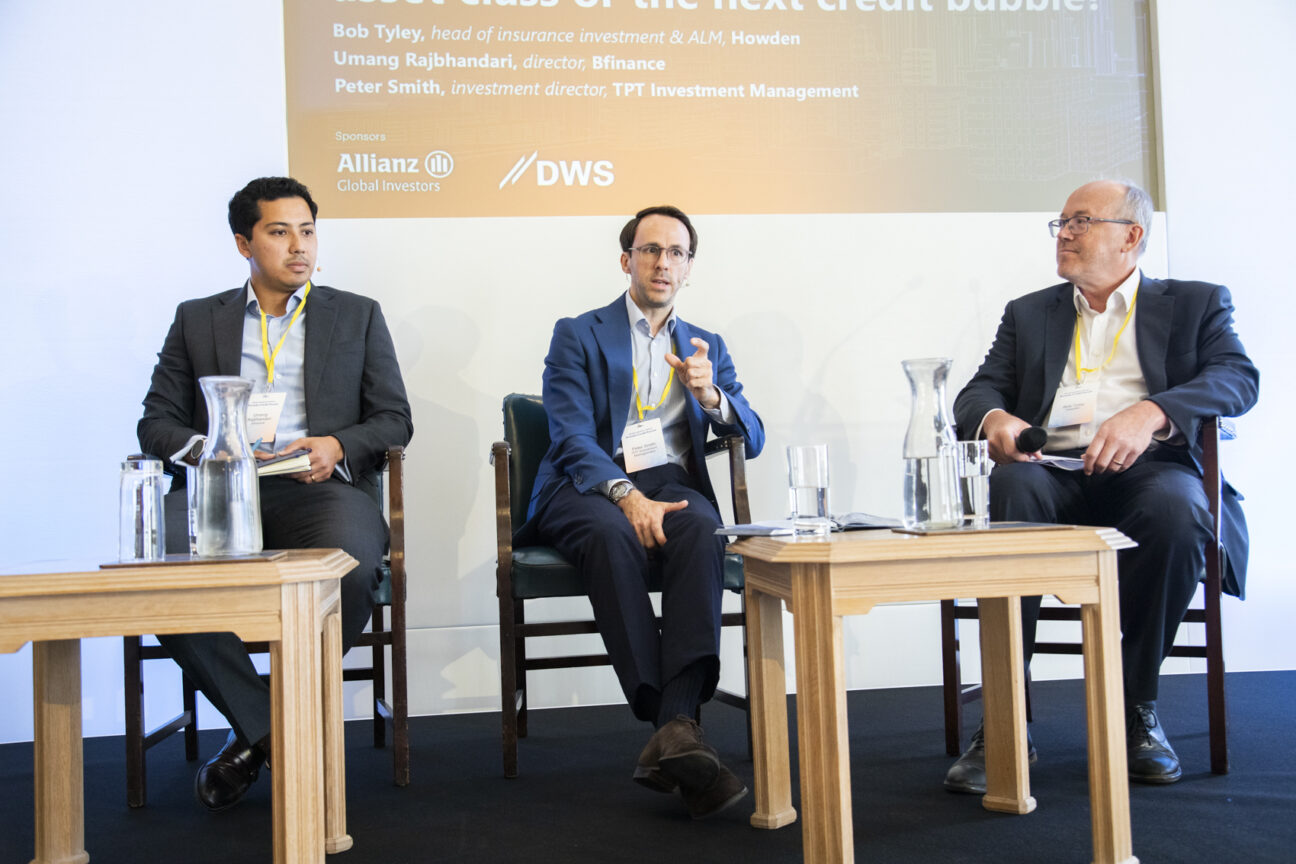
[L-R Umang Rajbhandari, Peter Smith and (chair) Bob Tyley]
Rajbhandari said investors could combine core allocations such as direct lending and infrastructure debt with diversifying strategies including NAV financing and private debt secondaries before adding higher-return opportunistic strategies where appropriate.
Smith argued that diversification should extend beyond appointing multiple managers pursuing the same strategy. “Appointing three managers that all do European direct lending is not really diversification.”
One area attracting increasing attention is asset-backed finance (ABF), which Smith described as a natural consequence of banks retreating from parts of the lending market.
“The reason why ABF is becoming popular is because ultimately there’s a gap in the market that’s been identified by asset managers that banks can’t fill – and they can fill it,” he said.
Institutional investment Conferences & Summits from Longview Networks
Smith also highlighted risk-sharing transactions as an emerging area of interest. “There are certain relationships that the banks will want to retain because they lead to other things,” he said. “They might be doing a loan that they don’t really want, but they want the banking relationship or the M&A relationship.”
As a result, institutional investors can gain exposure to investment-grade borrowers that may never directly seek private credit. “We looked at risk sharing because it basically provides access to investment-grade borrowers that are never going to go to the private market,” Smith said. “So that’s quite an interesting opportunity.”
The panellists also stressed the importance of manager selection and underwriting discipline. Rajbhandari highlighted team stability, organisational structure, track record and alignment of interests as important considerations when evaluating managers.
Smith added that investors should remain patient when deploying capital rather than feeling pressured to commit quickly. He concluded with a warning against relying too heavily on covenant packages: “A covenant is just a call to action to do something, it doesn’t replace good underwriting.”