



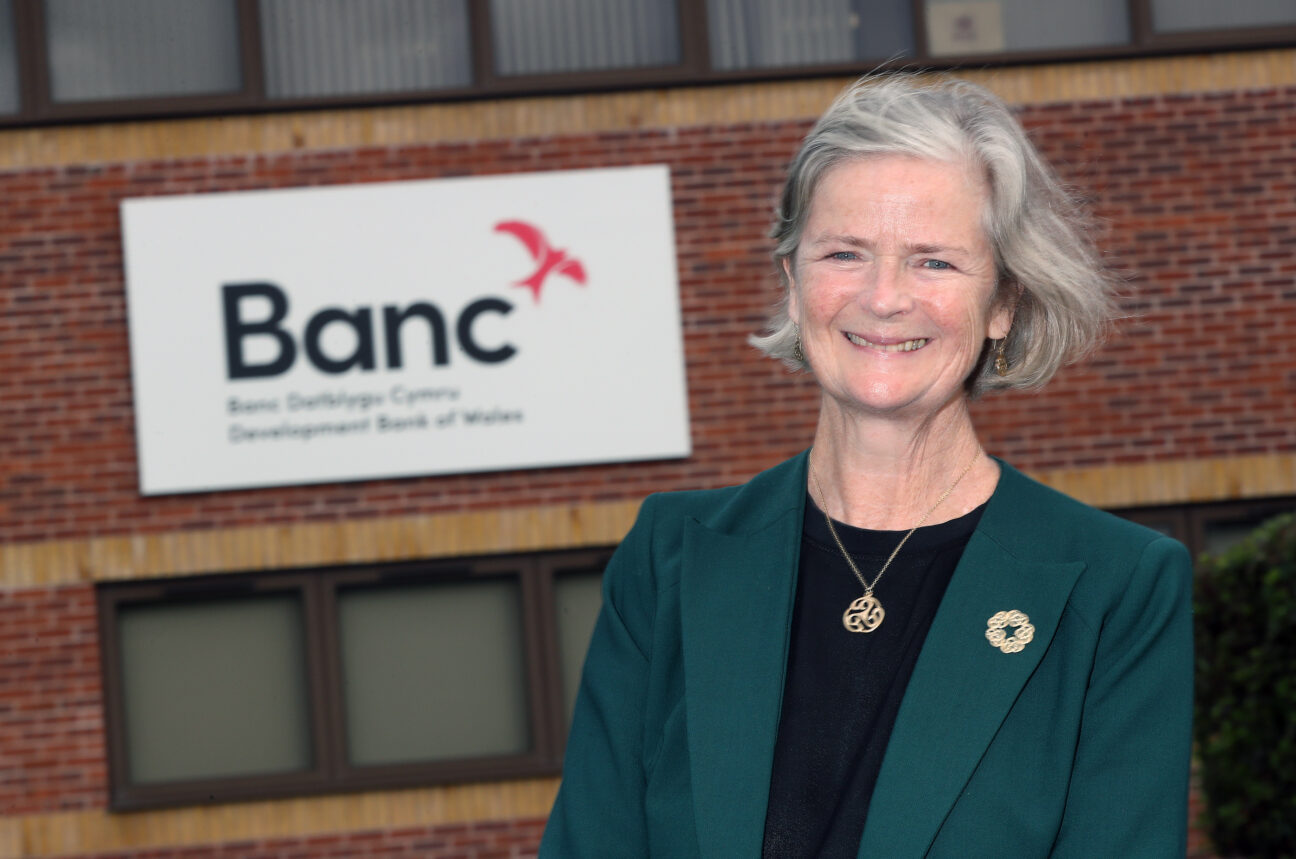
Development Bank of Wales chair Sally Bridgeland argues the nation should play to its natural strengths and nurture a distinctive investment ecosystem capable of supporting sustainable economic growth.
When politicians talk about productive finance, the conversation usually begins with how to convince Britain’s pension funds to invest more in the UK economy.
Reforms to the Local Government Pension Scheme (LGPS) and the creation of the National Wealth Fund are intended to unlock billions of pounds of institutional capital for infrastructure, housing, venture capital and regional development.

Yet many pension funds continue to argue that there are too few opportunities capable of meeting their fiduciary duties, governance requirements and return expectations.
Sally Bridgeland, chair of the Development Bank of Wales, says that institutions such as hers can play a crucial role in bringing the two sides together. “There is a lot of capital out there that funds want to deploy,” she tells PMP. “The challenge is that opportunities are hard to find, or simply untested. Most big institutional investors are not very good at investing in the last mile.”
Looking at Wales, what’s right for the terroir? Do we need to become better at supporting the smaller businesses?
Sally Bridgeland
Her perspective has been shaped over more than three decades working across pensions and investment. Bridgeland has been the chief executive of the BP Pension Fund and chaired two LGPS investment pools, among many other positions, giving her first-hand experience of regional investment policy and how pension funds assess opportunities. “The money is there to be invested,” she says. “The challenge is creating the wrapper around the opportunities.”
The Development Bank has become one of the Welsh Government’s principal economic development institutions since it replaced Finance Wales in 2017. It has invested more than £1 billion across thousands of Welsh businesses and projects through a combination of direct lending and equity finance. It leveraged this public capital to crowd-in £636 million of private co-investment.
Core Infrastructure Summit 2026 | 11 November | London
Following the Senedd election in May, the incoming Plaid Cymru leadership pledged to reshape the country’s eco nomic development landscape, with ambitions to increase funding to £1 billion per year and promising a review the organisations responsible for delivering it. The Development Bank is widely expected to play an important role.
Bridgeland believes development banks can become the missing link between public policy and private markets – helping governments translate economic ambition into opportunities that institutional investors are willing to finance.
Supporting development
The Development Bank provides finance to businesses, investing in early stage, start-ups, scale ups and management buyouts to property and infrastructure projects. Although wholly owned by the Welsh Ministers, it operates commercially, seeking both financial returns and wider economic impact.
It invests across the capital structure, supporting businesses from start-up through to succession, property development and infrastructure. That breadth gives it visibility across much of the Welsh private markets ecosystem and positions it to identify opportunities.
Bridgeland sees it increasingly acting as a ‘convener’ that brings together government, local authorities, pension funds and private investors to develop investment opportunities that no single entity could deliver independently.
“One of the challenges in Wales is making sure the ecosystem is joined up,” she says. “There is a role for somebody to make sure things are coordinated. Otherwise, different bodies from different places will do different things, with different funding approaches.”
Coordination has become increasingly important as policymakers seek to attract institutional capital into regional economies. Governments typically lack the expertise to structure investments in ways that appeal to institutional investors – while these same investors rarely possess the local knowledge to identify place-based opportunities.
“I come from the world of pensions,” she says. “My fluency is in under standing what LGPS funds, defined contribution schemes, insurance companies and other institutional investors are trying to achieve, their regulatory environment, and the boxes they’re trying to fill with investments.”
Her preferred analogy is a simple one. “It’s almost like providing a box of chocolates. Different people choose different ones depending on their favourites. It’s our role to break investments down into constituent parts and create funds that investors can join us in.”
The Development Bank’s role, she argues, is twofold: originating opportunities that the private sector might otherwise overlook and packaging them in ways institutional investors can understand. “There can be a big ‘lost in translation’ problem,” she says.
For Bridgeland, this translation is where the Development Bank can add the greatest value, and this increasingly shapes her vision for the ecosystem.
One of the challenges in Wales is making sure the ecosystem is joined up
Sally Bridgeland
Investable opportunities
For Bridgeland, attracting more institutional capital is about reducing the barriers that prevent them investing. “Pension funds can’t throw money at something they know is going to lose money. They are not responsible for subsidising, making grants or taking the biggest hit in terms of risk,” she says.
“The Government might need to effectively underwrite it in financial terms, as well as in policy terms, to give ex ternal investors the confidence that they won’t lose money at the riskier end of the market.”
In other words, the purpose of national development banks deploying public capital is to crowd-in private capital. This aligns with the wider direction of UK policy, where the National Wealth Fund, operating at larger ticket sizes, is attracting institutional investment by absorbing the risks that private markets cannot efficiently bear alone.
“If private markets investors can see an institution is willing to put its money where its mouth is, investors become interested in opportunities that nobody else has identified,” she says.
Institutional investment Conferences & Summits from Longview Networks
The Development Bank’s relationships with LGPS allocators are illustrative of how regional investing has been evolving. Historically, engagement was primarily with individual LGPS funds looking to support their immediate local economies. As pooling reforms gathered pace, Bridgeland says the Welsh Pensions Partnership (WPP) seems likely to become the Development Bank’s principal institutional counterpart. “Our customer is now more likely to be the pool than the local LGPS funds,” she says.
For the Development Bank, pooling creates the prospect of working with larger, more sophisticated institutional investors while retaining its role as a local originator of opportunities. “I would like things to move so we can draw in broader sources of finance, even be yond the UK pensions ecosystem.”
She appreciates that attracting capital from across the UK requires more than identifying attractive opportunities – it requires packaging them appropriately. “Most venture funds sound complicated, when they can actually be very simple. We need to make things simple,” she says.
The multiplier effect
Bridgeland’s thinking extends beyond making individual investments. Successful place-based investing, she argues, is about combining different forms of capital that become mutually reinforcing. “If we invest in infra structure, quality housing and start up businesses in the same area,” she says, “all boats will rise.”
Her holistic approach in built on a logical investment case. Infrastructure improves productivity. Better housing helps businesses attract staff. And growing businesses create demand for commercial property and local services. So, made together, separate investments can generate stronger returns than any one project might achieve in isolation.
The organisations involved in economic development therefore need to work towards shared objectives. “We tend to be very siloed,” she says. “Banking, government, pension funds – everybody works in their own space. Joining those dots is important.”
Bridgeland believes the challenge should be framed in terms of how investment opportunities can be structured to satisfy institutional requirements. “There are always incentives for the water to flow downhill once you’ve tilted things in the right direction and taken a few obstacles out of the way,” she says.
The Development Bank’s core role therefore is to design an ecosystem capable of attracting significantly more private capital than public money alone could deliver. Yet Bridgeland is clear this is only half of the challenge. Perhaps the harder questions are deciding what kind of economy Wales wants to build and what types of capital are best placed to support it.
The Welsh terroir
On the journey to strengthen the eco system, Bridgeland’s main challenge is deciding what kinds of businesses it should support. She is reluctant to identify any individual asset class or economic sector as the answer. “It’s mostly just about volume,” she says.
“We’re confident there’s more that could be done, whether it’s property or debt. Welsh companies have been less enthusiastic about private equity, although there has been a cultural shift and the money is there, as long as the offer is good and it’s stewarded by the right investment manager.”
While Bridgeland acknowledges the value that private equity managers can bring to businesses, she questions whether the traditional timeline is conducive to creating the desired outcome.
“The private equity model is very much around getting businesses ready for sale,” she says. “But is that really what we want for Wales? Is that what the end investor wants?’”
If we invest in infrastructure, quality housing and start-up businesses in the same area – all boats will rise
Sally Bridgeland
She argues for an alternative approach to ownership. “Institutional investors have more patience than the average private equity manager. Businesses that want to grow need owners alongside them who are going to be in it for the longer term.”
While growth certainly matters, so too does retaining successful businesses within the Welsh economy. This underpins the Development Bank’s emphasis on management succession for example helping businesses stay in Wales when their founders inevitably retire.
It also focuses on helping companies bridge the divide between early-stage finance and institutional-scale capital. “There is a gap between where we operate and institutional investors,” she says. “We’re hoping we can draw those two worlds together. The biggest opportunity is in scaling and staying.”
Matching companies’ scale to the local economy is key. Bridgeland reach es for a metaphor borrowed from French winemaking, arguing that every region has its own economic terroir – the unique local characteristics that determine which businesses are most likely to flourish.
“Looking at Wales, what’s right for the terroir? Do we need more companies like [insurance group] Admiral, or do we need to become better at supporting the smaller businesses and scaling up the start-ups that are the life blood of the economy?’”
It is an unusually reflective answer for an investment discussion. Rather than attempting to copy London or Scot land’s more developed financial eco systems, she believes Wales should build on its own strengths – whether that means focusing on renewable energy, agriculture, infrastructure, innovative SMEs or something else entirely.
If private markets investors can see an institution is willing to put its money where its mouth is, investors become interested
Sally Bridgeland
In practice this means supporting sectors that can benefit from the competitive advantages an area already possess such as natural resources, specialist industries, academic research or established supply chains.
Establishing a blueprint
Bridgeland is clearly enthusiastic about the potential of the Plaid Cymru government’s plans, but she is equally conscious that political ambition alone is not enough.
“Politicians can have wonderful ideas,” she says. “But these need to be translated into opportunities, and we need determine how we can wrap them up [into investible funds]. Success will mean those who’ve got the capital, actually provide it.”
Institutional investors will not necessarily need to be persuaded of the merits of regional investment; they need opportunities that meet their return objectives, satisfy fiduciary duty and can be implemented within con strained governance budgets.
Every UK nation and region faces similar questions. How do you create a credible investment pipeline? How do you crowd-in private investors rather than crowd them out? How do you combine infrastructure, housing, business finance and private investment into a coherent long-term strategy?
The Development Bank of Wales may not have yet solved all these questions. But Bridgeland suggests Wales can lead the way in creating ways for governments and institutional investors to work together more effectively. Its success will be measured in whether political ambitions can be turned into opportunities that investors are willing to back.
If she can demonstrate how that is done, the benefits will not be for Wales alone. It could offer a blueprint for every region seeking to connect public policy with private markets.