



Record-low distributions have forced investors to rethink private equity liquidity, with secondaries and continuation vehicles increasingly being used as portfolio management tools.
With private equity’s long-anticipated exit rebound yet to materialise, panellists at Private Markets Profile’s Inside the Deal event on Wednesday pointed to historically weak distribution levels and a growing backlog of unrealised assets. However, the tone was measured rather than alarmist: liquidity is constrained, but investors are adapting.
Richard Moon, head of private markets at Railpen, cited Bain data showing that from 2021 through 2024, distributions equated to just 10–13% of start-of-year NAV: “The first time in the history of the market that distributions have been that low”.
“There’s a record backlog,” added Mark Parry, principal and head of manager research at Barnett Waddingham.
To discuss opportunities in security and resilience with asset owners and fund managers, attend Longview Networks’ Defence and Security Investing Summit in London on 25 March.

For Parry, the current environment reinforces the importance of understanding liquidity at the point of entry. “When you’re considering any form of private markets, [you need] to make sure you understand the timelines and the risk and the liquidity,” he said. In a higher-rate environment, investors are no longer “blindly seeking return” but weighing risk, return and liquidity more deliberately.
The most visible adaptation has been the rise of secondaries; they are no longer being viewed as a tactical exit mechanism, instead they are increasingly being embedded into portfolio construction.
Louise Laurent, senior associate in private equity at bfinance, said liquidity tools are becoming structural. “Secondaries are a common liquidity tool now. It’s less of a tactical approach, but more of a structural portfolio management tool,” she said. Rather than reactive sales, LPs are proactively using secondaries to manage exposures and, in some cases, to self-fund commitments.
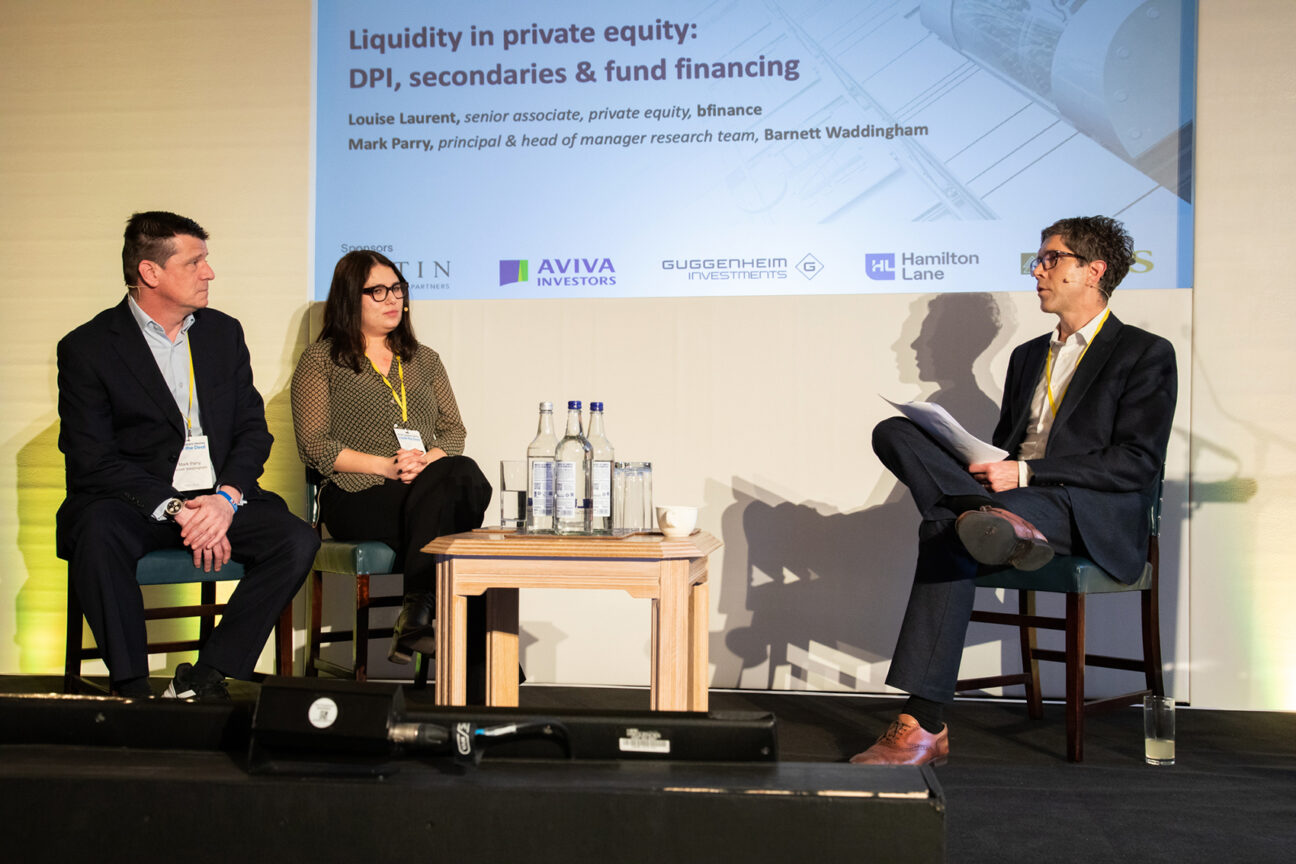
L-R Mark Parry, Louise Laurent and Richard Moon
Continuation vehicles (CVs), once viewed with scepticism, are also being assessed more pragmatically. “The question isn’t necessarily whether they’re good or bad, but the intentionality behind them,” Laurent said.
Parry echoed that sentiment, arguing that CVs require case-by-case analysis. “Is it something that has naturally come to the end of its life, and there’s a good reason for extending? … Or is it something that keeps getting extended?”. Therefore, alignment between GPs and LPs is of central importance.
Moon offered a practitioner’s perspective. With an 11-person private markets team, Railpen has been able to treat single-asset continuation vehicles similarly to co-investments, often rolling exposure and occasionally upsizing positions where alignment is strong. But he acknowledged that such flexibility is resource-dependent, and not all asset owners can take the same approach.
The secondary market itself is evolving. Laurent noted the rise of specialist funds and GP-led strategies, alongside increasing capital flowing into evergreen and semi-liquid vehicles. Pricing dynamics are shifting as a result. On LP stake transactions, she observed average pricing around 8%of NAV for closed-ended vehicles, compared with closer to 90% for open-ended structures, often backed by retail capital.
Institutional Investment Conferences & Summits from Longview Networks
For Parry, additional liquidity in the system is broadly constructive – provided risks are understood. “Choice generally is a good thing for investors,” he said, but governance standards must remain consistent, particularly where DC or retail capital is involved.
Moon cautioned against becoming forced sellers during periods of dislocation, noting that pricing in 2022 appeared unattractive amid heavy supply. Today, he suggested, pricing for older vintages looks more reasonable, and secondaries are likely to remain an active part of portfolio management.
The panel’s consensus was that liquidity stress is real – but it is not existential. Instead, it is accelerating a shift: secondaries and structured liquidity planning are becoming embedded features of private equity portfolios, rather than emergency valves.
In a slower exit world, adaptability rather than retreat appears to be the prevailing response.
Inside the deal: Secondaries
As the secondaries market continues to expand, asset owners remain focused on governance, pricing and alignment, especially as continuation vehicles (CVs) become an increasingly prominent part of private equity exits.
Antony Anastasiadis, managing director at Hamilton Lane, described a market that has evolved from traditional LP stake sales into a broader liquidity and portfolio management tool.
For sellers, secondaries provide flexibility to shorten duration or pivot away from specific sectors. For buyers, they offer what he characterised as a lower-risk, shorter-duration profile compared with primary buyout investing, with reduced J-curve effects.
Anastasiadis illustrated the trend with a recent £1.5 billion multi-asset continuation vehicle involving two companies carved out of a 10-year-old fund. Investors were offered a choice: exit at par or roll into the new vehicle. He noted that in similar transactions, typically 60–80%of LPs elect liquidity, with the remainder reinvesting.

L-R Vivian Liu, James Monk and Antony Anastasiadis
However, representatives from Fidelity International — James Monk, investment director, and Vivian Liu, head of private market portfolio management — focused their questioning on potential conflicts and structural considerations.
Anastasiadis acknowledged that in GP-led deals, “the GP… [is] both buyer and seller,” requiring an arm’s-length third-party pricing process. Alignment was another key theme. He said GP commitments in continuation vehicles average around 8%, compared with 1–2% in traditional fund structures, and emphasised the importance of management teams rolling capital alongside investors.
Fee structures were also discussed. Management fees on CVs have declined materially, often below 1% of invested capital, with more tiered performance hurdles than in blind-pool primaries.
On exits, Anastasiadis argued that CVs are not solely a product of a weak M&A environment. Even in 2021 — a strong distribution year — the GP-led market grew, and last year CVs accounted for roughly 20% of private market exits. While he expects them to remain mainstream, he acknowledged ongoing investor scepticism and the continued importance of traditional trade sales and IPOs.
The discussion underscored a broader shift: secondaries are increasingly embedded in portfolio management, but institutional investors are applying tighter scrutiny as the strategy matures.