


In the crowded world of private credit, non-sponsored lending, real estate debt and significant risk transfer transactions are three areas that still offer space for opportunity. Cheyne’s Duncan Sankey and Nicole von Westenholz explain.
The 2024 LGPS Survey conducted by Room 151 and Schroders found that 74% of respondents felt there was a lack of UK opportunities providing sufficient financial return. It also found that 42% of respondents plan to increase their allocation to private credit.
The market for direct lending to the corporate middle market (typically backed by private equity firms, aka financial sponsors) has undergone transformational growth: to $1.5tn at the beginning of this year – up 50% since 2020 – with the potential to grow to $2.8tn by 2028 according to Morgan Stanley. JP Morgan estimates that it could be up to $3.1tn already, including ‘dry powder’. In short, it has become a crowded trade.
And with an influx of money has come a concentration of managers, an erosion of creditor defences and a proliferation of ever-more esoteric applications. The events last summer at online IT training provider Pluralsights, where sponsors moved collateral as part of a cash injection (diluting security available to creditors), dispelled the notion of collegiality between participants in private debt deals. Meanwhile, private debt managers now fund consumer, auto and home equity and equipment loans and even provide financing to one another. When Blue Owl bought $2bn of consumer loans from Upstart, Apollo provided financing to Blue Owl; ‘Private Debt Squared’ does not have a good ring to it.
The market for direct lending to the corporate middle market has undergone transformational growth
To date, default rates across the board have remained manageable (although more on this below). However, private debt valuations are opaque. Fortunately, given that around 40% of private debt assets reside at US business development corporations (BDCs), which do publicly report loan-level holdings, we have an oblique insight into valuations but it is not encouraging. The Financial Times noted a 13.5c variation in the valuation of Pluralsights holdings. Moreover, the market is witnessing a potentially worrying growth in payment-in-kind (PIK) transactions, often harbingers of incipient credit distress. Data compiled by various sources, including the International Monetary Fund’s (IMF) Global Financial Stability Report, estimate that PIK income in BDC portfolios has more than doubled over the last five years to an average of 9% and is running as high as 20% in some instances.
PIK income as share of interest and dividend income of US BDCs (%)
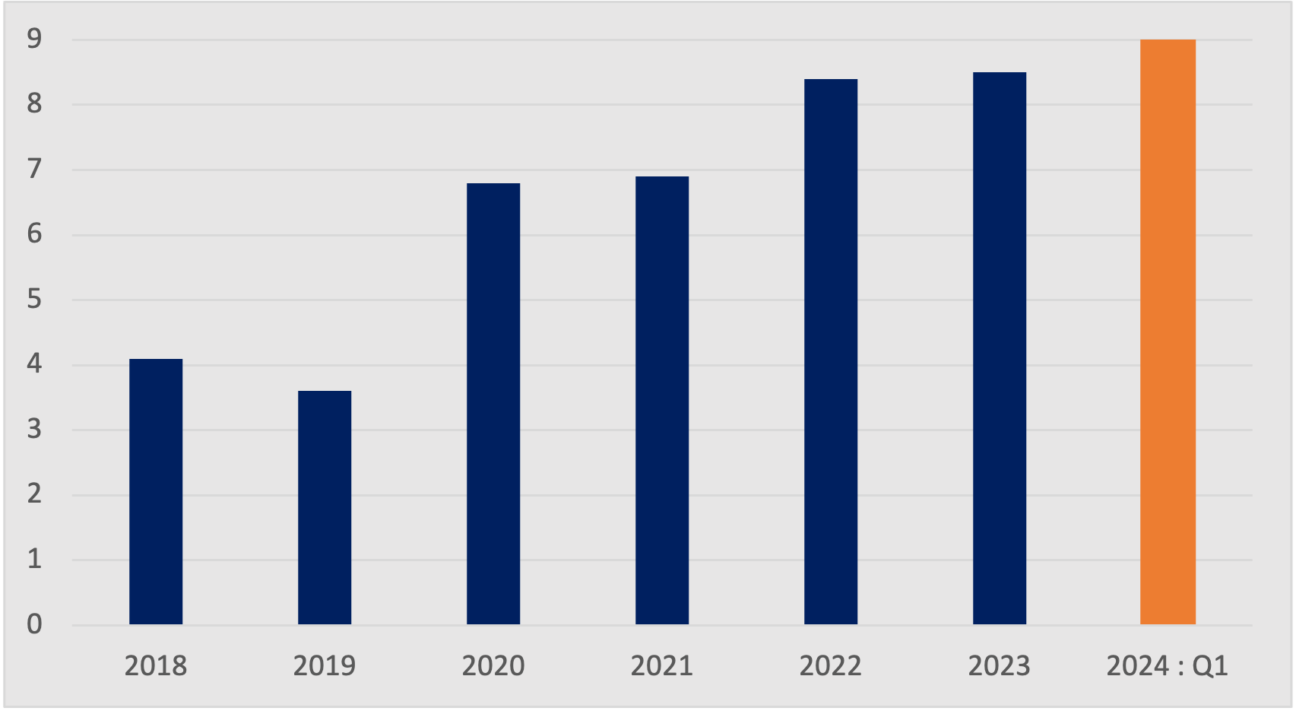
Source: International Monetary Fund’s Global Financial Stability Report, October 2024
If rapid growth and diversification into more exotic asset classes, Daedalian structures, opaque valuations, PIK-ing, etc. all sound a bit 2008, there are alternatives; private debt is not a monolith nor, in parts, is it a crowded trade. We touch here on three less crowded strategies which offer double-digit returns and, in our view, compelling downside protection. Handily, they can also be tailored to focus only on the UK, if desired.
Non-sponsored corporate lending
Around 85-90% of direct lending in the UK is focused on ‘sponsor-backed’ businesses, i.e. those owned by private equity. However, private equity-backed businesses account for only a fraction of total businesses in the UK. As an indication of this, employees in private equity-backed businesses only comprise 10% of the UK’s private sector workforce.
UK sponsor-backed versus private deals (as % of 200 total deals – last 12 months)
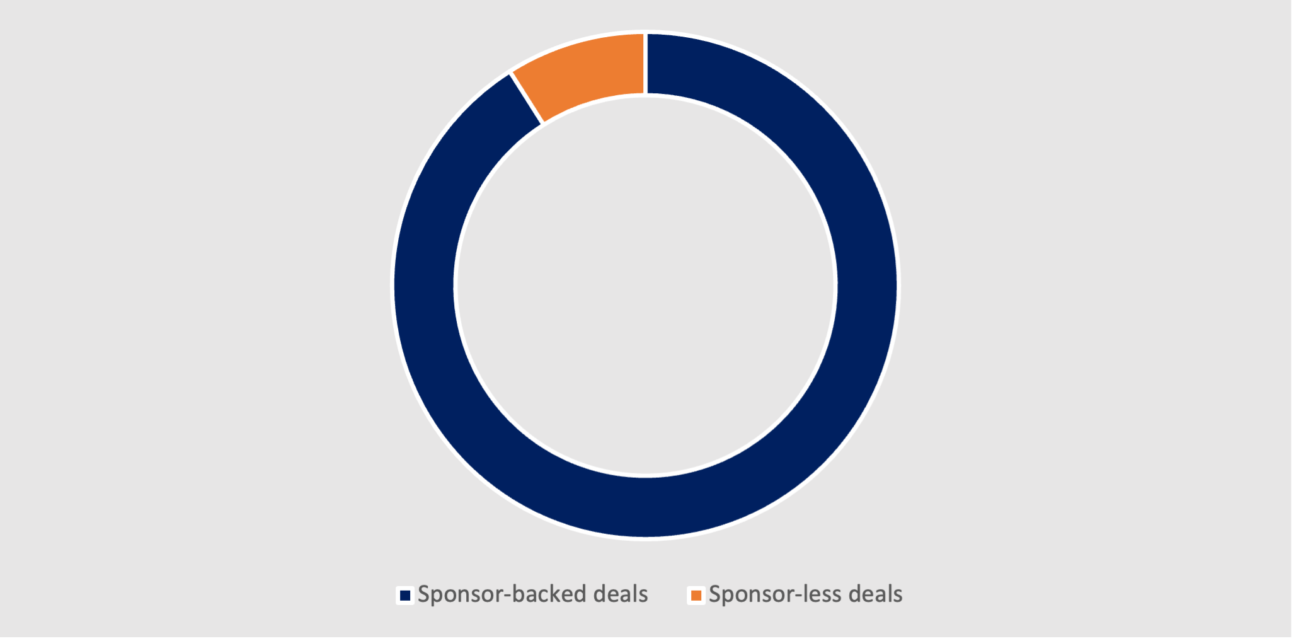
Source: Deloitte Private Debt Deal Tracker Autumn 2024
UK private sector workforce

Source: Bank of England, Financial Stability Report, June 2024
The aforementioned over crowdedness of the mainstream (sponsor-backed) direct lending market has resulted in lax lending standards which, combined with rising rates, did prompt an increase in default rates last year, albeit from low levels. In October 2024 alone, 821 private credit corporate defaults were recorded across the US and Europe. A tactic used by private debt funds to avoid a default may be to ‘amend and extend’, which allows the debt to continue to be marked at par. However, the extension only serves to defer the inability to refinance for a couple of years and the problem will ultimately still need to be dealt with. In 2024 we witnessed more than 60 debt extensions in Europe.
Being uncrowded and typically the preserve of senior and experienced lending specialists, the market for lending to family-owned / founder-led (non-sponsor-backed) businesses is characterised by transaction documentation where the lender holds the pen and ensures the agreements are highly structured and tightly negotiated directly with the borrower. In addition to a comprehensive suite of traditional lender protections, financing agreements will typically include extensive governance rights, including a board observer seat to monitor execution of the management plan and ensure adequate institutional controls are applied. This serves to maximise downside protection and capital preservation in deals which typically see mid- to high-teen returns. Moreover, in non-sponsored lending, the loan goes directly to the business for use as expansion capital etc., rather than to the seller of a business that is acquired by a private equity sponsor.
Real estate debt
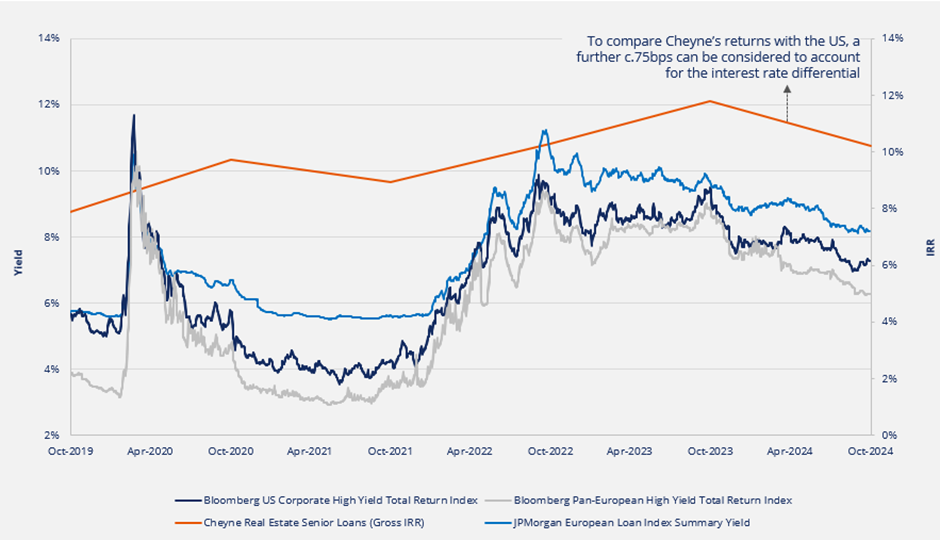
A dearth of competition and high barriers to entry lead to yields which have long persisted at compelling levels in UK and European real estate lending. A manager with good workout capabilities who, in a worst-case scenario, has to ‘take the keys’ on a property will often realise a greater return in this downside scenario than in the base case scenario of the loan being repaid on time. Of course, there are borrowers to avoid – Cheyne chooses to work with large, established borrowers who have meaningful equity participation in its deals. There are also sectors to avoid – Cheyne favours the ‘living’ sectors – housing, co-living, later living, student accommodation and is very selective about office assets, only lending against those aiming to achieve the highest sustainability credentials which corporate tenants need to occupy to be able to meet their own ESG commitments.
UK & European real estate lending versus high yield bonds
Significant risk transfer
Risk transfer transactions with banks (formerly ‘regcap deals’, latterly significant risk transfer (SRT) transactions) have been around for over two decades and the combination of banks’ desire to meet capital needs without tapping expensive equity with growing regulatory acceptance of SRTs (especially by the Fed) augur well for sustainable growth; such growth, to date, has not materially compromised returns, which sit in the low-mid teens.
Roughly two-thirds of the underlying in SRTs is corporate credit or SME loans and, since banks are incentivised to include assets based on capital efficiency rather than economic risk, investors benefit from regulatory arbitrage, often accessing the highest quality bank assets (secured, undrawn revolvers) for a compelling return.
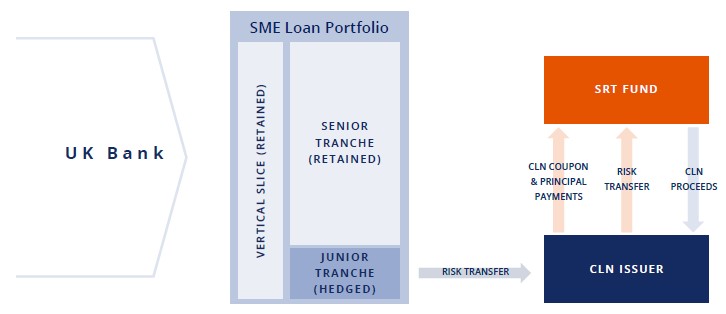
Banks typically retain a vertical slice of the reference portfolio as well as the senior portion (i.e., they have skin in the game) and remain responsible for workouts. Part of the attraction of SRTs for banks is that they retain the relationship with borrowers and thereby the ability to market higher-return, non-credit products.
Banks’ ongoing need for capital relief discourages adverse selection, which is in any case frustrated by information firewalls: relationship managers do not typically know if loans will be placed in a pool, nor will workout specialists typically be informed whether an NPL has been hedged. Finally, the structure – writing of protection on the equity tranche of a loan portfolio through a CLN (which does not get ‘bailed in’ should the bank be rescued) – is tried and tested.
By issuing SRT transactions linked to SME loan portfolios, UK banks can release capital which can be used to support further SME lending. SRT transactions facilitate an attractive multiplier effect for credit transmission to the UK economy.